Oct 26, 2026Incubator Buying Guides
How to Choose a Professional Reptile Egg Incubator for Commercial Breeding
Discover how to choose a professional reptile egg incubator for commercial breeding. Compare compressor cooling, PTC heating, humidity control, capacity, shelves, and OEM/ODM options.
How to Choose a Professional Reptile Egg Incubator for Commercial Breeding
A Complete Buyer's Guide to Temperature Control, Compressor Cooling, PTC Heating, Humidity Management, Incubation Capacity, and Commercial Breeding Equipment
Choosing the right reptile egg incubator is an important investment for any professional reptile breeder or commercial breeding facility.
Whether you are breeding snakes, geckos, lizards, turtles, or other egg-laying reptiles, maintaining appropriate incubation conditions is essential for healthy embryo development and reliable breeding management.
Unlike small hobby setups, commercial breeding operations often handle multiple clutches, different incubation schedules, and larger numbers of incubation containers. This creates additional demands for equipment capacity, environmental stability, organization, and maintenance.
A professional reptile egg incubator should therefore provide more than heating alone.
In this guide, Vantico Reptile explains the key factors to consider when selecting a professional reptile incubator, including compressor cooling, PTC heating, temperature and humidity control, internal capacity, shelving systems, and OEM/ODM customization.
1. Why Commercial Reptile Breeding Requires Professional Incubation Equipment
For small-scale hobby breeders, a compact incubator may be sufficient for a limited number of eggs.
However, as a breeding operation expands, managing incubation conditions becomes more complex.
Commercial breeding facilities may need to accommodate:
- Multiple reptile species
- Different egg incubation periods
- Several clutches at the same time
- Large numbers of incubation containers
- Continuous equipment operation
- Regular monitoring and maintenance
- Seasonal changes in room temperature and humidity
These requirements make equipment selection especially important.
A professional incubator can provide a more controlled and organized environment for incubation management.
However, no incubator can guarantee successful hatching. Egg fertility, species-specific conditions, handling procedures, hygiene, and breeding management all influence the outcome.
The most suitable equipment is the one that matches your actual breeding requirements.
2. Compressor Cooling: Why It Matters for Reptile Incubation
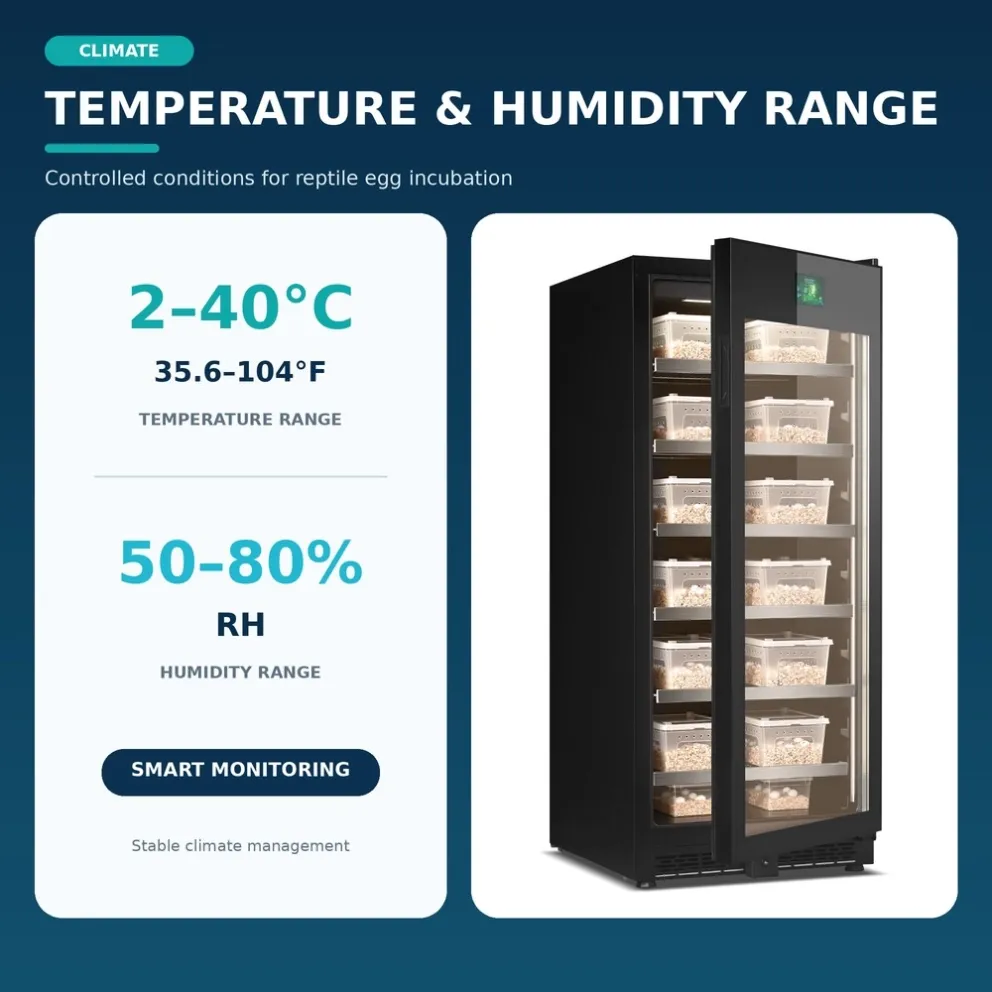
One of the most important differences between basic incubators and more advanced temperature-controlled cabinets is their ability to actively cool the interior.
What Is Compressor Cooling?
Compressor cooling uses a refrigeration system to remove heat from the cabinet.
This allows a suitably designed incubator to maintain internal temperatures below the surrounding room temperature, within its specified operating limits.
For reptile breeders, this can be especially valuable in warm climates or facilities where room temperatures fluctuate.
The Limitations of Heating-Only Incubators
A heating-only incubator can raise the temperature inside the chamber when the surrounding environment is too cold.
However, it cannot actively remove heat when the room becomes warmer than the desired incubation temperature.
For example, if a breeding room reaches 34°C (93.2°F) while a species requires an incubation temperature near 29°C (84.2°F), a heating-only system cannot reliably lower the internal temperature to the desired level.
An incubator equipped with appropriate active cooling capability may be better suited to these conditions.
Advantages of Compressor Cooling
1. Active temperature reduction
A compressor cooling system can help maintain lower temperatures when surrounding conditions are warmer than the required setpoint.
2. Greater environmental flexibility
Heating-and-cooling equipment can be useful for breeding facilities located in regions with significant seasonal temperature changes.
3. Support for temperature-sensitive applications
Some reptile breeding programs require careful control over incubation temperatures.
A properly designed cooling system can help manage the environment within the equipment's rated performance range.
4. Compatibility with larger cabinet designs
Compressor-based refrigeration is commonly used in larger temperature-controlled cabinets requiring active heat removal.
What Should Buyers Check?
Not all compressor-cooled incubators perform identically.
Before purchasing, ask the manufacturer about:
- Rated cooling temperature range
- Recommended ambient operating temperature
- Temperature control accuracy
- Temperature uniformity throughout the cabinet
- Compressor reliability
- Refrigerant type and local regulatory requirements
- Power consumption and electrical specifications
Buying tip: A wide adjustable temperature range does not necessarily mean the incubator can maintain every temperature under all ambient conditions. Always confirm actual cooling performance.
3. PTC Heating: Reliable Heating for Incubation Applications
In addition to cooling, many professional reptile incubators incorporate an electric heating system.
One available heating technology is PTC heating, which stands for Positive Temperature Coefficient heating.
How Does PTC Heating Work?
PTC heating elements use materials whose electrical resistance increases as their temperature rises.
This characteristic can help limit the heating element's temperature under designed operating conditions.
In an incubator, the heating element operates together with a controller and temperature sensors to regulate the cabinet environment.
Benefits of PTC Heating
Controlled heat generation
A properly designed system can supply heat when the internal temperature falls below the desired setting.
Compact construction
PTC heating elements can be integrated into space-efficient temperature-control systems.
Suitable for automatic temperature management
When connected to an electronic controller, PTC heaters can operate as part of an automated heating system.
Useful in cooler environments
Heating capability is important when the breeding room temperature is below the required incubation temperature.
Why Combine Compressor Cooling and PTC Heating?
A professional incubator equipped with both systems can respond to environmental conditions in two directions.
Environmental Condition | Required Function |
|---|---|
Room temperature is below the incubation setpoint | Heating |
Room temperature is above the incubation setpoint | Cooling |
Room temperature is near the setpoint | Precise control and monitoring |
This flexibility can be useful for reptile breeding facilities with changing seasonal temperatures.
However, the equipment must be designed to coordinate heating and cooling correctly to prevent unnecessary energy consumption, excessive temperature cycling, or unstable operation.
4. Temperature Control: Accuracy, Stability, and Uniformity
Temperature is a critical factor in reptile egg incubation.
Commercial buyers should look beyond the temperature range listed in a product catalog.
Three important performance characteristics deserve attention.
Temperature Accuracy
Temperature accuracy describes how closely the measured or controlled temperature corresponds to the actual temperature.
For example, a display showing 29°C does not automatically guarantee that every egg container is at exactly 29°C.
Sensor placement, calibration, airflow, and cabinet loading can influence readings.
Temperature Stability
Stability refers to how consistently the incubator maintains conditions over time.
Large or frequent fluctuations can create unfavorable incubation conditions.
Professional buyers should ask for temperature performance information under realistic operating conditions.
Temperature Uniformity
Uniformity refers to how similar the temperatures are at different locations inside the cabinet.
This is particularly important for tall, multi-level reptile incubators.
Potential differences may occur between:
- Upper and lower shelves
- Front and rear sections
- Areas near cooling outlets
- Areas near heating components
- Heavily loaded and lightly loaded sections
A well-designed air circulation system can help reduce temperature variation.
However, air circulation alone does not guarantee identical temperatures throughout the cabinet.
Professional recommendation: Test temperature at several shelf positions with calibrated independent sensors before beginning a large-scale incubation project.
5. Humidity Control: An Essential Part of Reptile Egg Incubation
Humidity and moisture management play important roles in reptile egg development.
Reptile eggs exchange water with their surroundings, and incorrect moisture conditions can negatively affect embryo development.
Why Humidity Matters
Insufficient moisture may lead to excessive water loss, while excessively wet conditions may contribute to condensation, mold, and poor gas exchange.
The correct approach depends on the species, incubation substrate, container design, and ventilation system.
Important Humidity Management Features
When evaluating a professional reptile incubator, consider:
Humidity monitoring
A digital humidity display or independent hygrometer can help operators monitor environmental conditions.
Humidity adjustment
Some incubator models provide active humidity control, while others rely primarily on the moisture content of incubation media and containers.
Ventilation
Proper gas exchange is necessary during incubation. Ventilation should be considered alongside moisture management.
Condensation management
Excessive condensation can create undesirable wet conditions inside the cabinet.
Does Every Breeding Facility Need Automatic Humidity Control?
Not necessarily.
Some breeders manage moisture inside individual incubation containers rather than controlling the entire cabinet to a fixed relative humidity.
This can be useful when the incubation media and egg container design provide the required microenvironment.
Before ordering, confirm whether a particular incubator offers:
- Humidity monitoring only
- Active humidification
- Active dehumidification
- Automatic humidity regulation
These functions are different and should not be treated as interchangeable.
6. Choosing the Right Incubator Capacity for Your Breeding Operation
Capacity is one of the most important purchasing considerations for a commercial reptile breeding facility.
Choosing a cabinet that is too small can limit operational flexibility, while purchasing equipment that is unnecessarily large can increase initial investment and operating costs.
Small Incubators for Individual Breeders
Compact units are suitable for hobby breeders, small breeding rooms, and operations managing relatively few clutches.
Advantages may include:
- Smaller footprint
- Easier installation
- Lower initial equipment investment
- Convenient management of limited egg batches
Medium-Capacity Incubators for Growing Breeding Businesses
Medium-sized cabinets can be useful for breeders expanding their incubation operations.
They may offer:
- More internal storage space
- Multiple shelf levels
- Better organization of incubation containers
- Greater flexibility for seasonal production
Large Commercial Incubator Cabinets
High-capacity incubators are designed for operations that need more organized space for multiple egg containers.
They can be useful for:
- Commercial reptile breeding facilities
- Specialist reptile farms
- Professional breeding projects
- Multi-clutch incubation management
- Breeding operations planning future expansion
Cabinet Volume Is Not the Same as Egg Capacity
An incubator advertised as 300L, 400L, or 760L does not necessarily have the same usable incubation capacity as another cabinet with a similar total volume.
Actual capacity depends on:
- Internal dimensions
- Number of usable shelves
- Shelf spacing
- Size of incubation containers
- Airflow clearance requirements
- Available space around the containers
Important: Avoid selecting an incubator based only on the advertised liter capacity.
A Practical Capacity Planning Method
Before purchasing, calculate the space required for your actual incubation containers.
For example, suppose your breeding operation uses containers measuring 300 × 200 × 120 mm.
You should first determine how many containers fit on each shelf while maintaining appropriate access and airflow clearance.
Then calculate the total usable shelf positions across the cabinet.
For expansion planning, consider the maximum number of clutches that may require incubation simultaneously rather than the total number of eggs produced in a year.
Keeping spare usable capacity can also help accommodate unexpected breeding peaks.
7. Shelving Systems: Why Internal Layout Matters
The internal shelving system is especially important in professional and commercial reptile incubators.
A cabinet may have sufficient total volume but still be inconvenient to use if the shelf spacing or layout does not match the breeder's incubation containers.
Removable Shelves
Removable shelves allow operators to reorganize the internal space based on container dimensions.
They can also make cleaning and maintenance more convenient.
Adjustable Shelf Spacing
Adjustable spacing may help accommodate different container heights.
For breeders working with multiple reptile species, this provides greater flexibility.
Shelf Load Capacity
Commercial operators should verify the load-bearing capacity of each shelf.
Incubation containers containing substrate, eggs, and moisture can add significant weight.
Stainless Steel Shelves and Trays
Depending on the cabinet model, stainless steel shelving may provide advantages such as:
- Corrosion resistance
- Convenient cleaning
- Durable construction
- Suitability for repeated use
Airflow Considerations
Shelves and incubation containers should not obstruct essential air circulation pathways.
Proper spacing can help the cabinet maintain more consistent environmental conditions.
Buying tip: Ask the supplier for detailed internal dimensions, shelf spacing, shelf quantity, and shelf load ratings before confirming an order.
8. Fan-Assisted Air Circulation and Ventilation
Air circulation is another important consideration when evaluating larger incubator cabinets.
Fan-assisted systems circulate air within the chamber to help distribute heating or cooling effects.
Why Air Circulation Is Useful
In large cabinets, different shelf positions may experience different temperatures.
A well-engineered circulation system can help reduce these differences.
However, fan placement and airflow intensity must be considered carefully.
Excessively strong airflow or unsuitable ventilation can affect moisture conditions inside incubation containers.
Air Circulation Is Not the Same as Fresh-Air Ventilation
These two functions are often confused.
Air circulation redistributes air inside the cabinet.
Ventilation allows gas exchange with the surrounding environment.
Reptile embryos require appropriate oxygen availability and carbon dioxide removal.
For commercial incubation equipment, both temperature distribution and gas exchange should be considered as part of the overall design.
9. Smart Temperature Controllers and Monitoring Features
Professional breeding facilities benefit from equipment that is easy to monitor and operate.
Depending on the model, useful control features may include:
- Digital temperature displays
- TFT touch-screen control panels
- Heating and cooling status indicators
- Temperature alarm functions
- Humidity monitoring
- Adjustable setpoints
- Sensor-based control systems
- Remote monitoring options
Why Monitoring Matters
Commercial operations may run incubation equipment continuously for extended periods.
A clear control interface allows staff to check conditions efficiently.
Independent monitoring devices and data logging can provide additional confidence, especially for valuable breeding projects.
Ask About Alarm and Backup Features
When comparing incubators, consider whether the system supports:
- High-temperature alerts
- Low-temperature alerts
- Sensor fault detection
- Power interruption notifications
- External monitoring systems
Feature availability must be verified for the specific model.
For larger facilities, an independent alarm and emergency power plan may be as important as the incubator itself.
10. Commercial Incubator Comparison Checklist
Before purchasing equipment, compare different models using a consistent checklist.
Feature | What Commercial Buyers Should Check |
|---|---|
Cooling System | Compressor cooling capability and ambient operating limits |
Heating System | Heating method, including PTC where available |
Temperature Control | Range, accuracy, stability, and uniformity |
Humidity | Monitoring versus active control |
Capacity | Usable internal volume and actual container capacity |
Shelves | Quantity, spacing, material, and load capacity |
Air Circulation | Air distribution design and operating conditions |
Ventilation | Suitable gas exchange provisions |
Control Panel | Digital display or touch-screen interface |
Reliability | Component quality, testing, and operating guidance |
Electrical Requirements | Voltage, frequency, plug type, and certifications |
Customization | OEM/ODM options and model-specific availability |
After-Sales Support | Warranty terms, spare parts, and technical assistance |
A professional supplier should be able to provide clear technical information and explain which models fit your breeding application.
11. OEM/ODM Reptile Incubator Solutions for Distributors
For importers, wholesalers, and reptile equipment distributors, the right manufacturing partner is just as important as the right product.
OEM/ODM services can help distributors establish their own product line or adapt equipment for different markets.
Common Customization Requirements
Depending on production capabilities and order quantities, customization may include:
- Private-label branding
- Logo placement
- Product appearance and door designs
- Shelf configuration
- Control panel options
- Temperature settings and application-specific features
- Product packaging
- Multilingual manuals
- Market-specific electrical configurations
For distributors entering new markets, it is important to confirm certification requirements and technical feasibility before production.
Questions to Ask a Reptile Incubator Supplier
Before starting a wholesale project, ask:
- What models and capacities are available?
- What are the minimum order quantities?
- Can the products be customized with our brand?
- Which electrical standards can be supported?
- What certifications are available for the selected models?
- What is the production lead time?
- What warranty and spare parts support is provided?
- Can the supplier provide detailed technical specifications and product testing information?
A reliable supplier should answer these questions clearly and provide documentation where applicable.
12. Professional Reptile Incubators from Vantico Reptile
Vantico Reptile provides reptile incubation equipment solutions for professional breeders, distributors, and commercial breeding facilities.
Our product range includes compact incubators and larger multi-level incubation cabinets designed for different operational requirements.
Depending on the selected model, features may include:
- Compressor cooling systems
- PTC heating technology
- Digital temperature control
- TFT touch-screen interfaces
- Fan-assisted air circulation
- Removable shelf systems
- Temperature and humidity monitoring or control options
- OEM/ODM customization services
VT-345 Professional Reptile Egg Incubator
The VT-345 is a professional reptile egg incubator designed for organized, multi-level incubation applications.
Its design incorporates compressor cooling, fan-assisted air circulation, and movable shelving for convenient incubation container management.
The model can be considered by breeders seeking a cabinet-style solution for larger-scale incubation projects.
Customers should request the full technical specification sheet to confirm exact dimensions, temperature performance, humidity functions, electrical requirements, and shelf capacity.
Solutions for Different Breeding Scales
Whether you are starting a breeding business or expanding an established facility, selecting suitable equipment requires an understanding of your daily workflow and future capacity needs.
Our team can assist with product comparisons, model selection, wholesale inquiries, and customization discussions.
13. Frequently Asked Questions
What is the difference between a regular incubator and a professional reptile incubator?
A professional reptile incubator may provide greater usable capacity, more advanced environmental control, improved monitoring, and internal layouts suited to reptile egg containers. Actual features depend on the equipment model.
Is compressor cooling necessary for reptile egg incubation?
Not always. It becomes particularly useful when the surrounding room temperature may exceed the desired incubation temperature. Heating-only units may be sufficient in some controlled environments.
Why is PTC heating used in reptile incubators?
PTC heating elements provide controlled electric heat and can be integrated into automated heating systems. Appropriate temperature regulation still depends on the overall controller and sensor design.
Should I choose an incubator with automatic humidity control?
This depends on the species, container system, and incubation method. Some breeders manage humidity within individual containers, while others benefit from cabinet-level humidity monitoring or active control.
How many reptile eggs can a commercial incubator hold?
Egg capacity depends on clutch size, incubation container dimensions, shelf layout, and required spacing. The manufacturer's cabinet volume alone is not enough to determine the exact egg capacity.
Can different reptile species share the same incubator?
Only when their incubation requirements are compatible. Species requiring different temperatures may need independently controlled compartments or separate incubators.
What should distributors look for in a reptile incubator manufacturer?
Distributors should evaluate product quality, technical specifications, customization capabilities, certification availability, lead times, after-sales service, and the supplier's ability to support long-term cooperation.
Can reptile incubators be customized for different markets?
Many manufacturers offer selected OEM/ODM options, but customization availability, minimum quantities, and certification requirements should be confirmed before ordering.
14. Final Thoughts: Choosing the Right Incubator for Long-Term Growth
The best reptile egg incubator is not necessarily the largest or most expensive model.
It is the equipment that provides the required environmental control, usable capacity, internal organization, and reliability for your breeding operation.
When comparing professional reptile incubators, prioritize:
- Suitable temperature control performance
- Heating and cooling capability when required
- Appropriate humidity management
- Practical cabinet capacity and shelving layout
- Effective airflow and ventilation design
- Convenient monitoring and maintenance
- Reliable technical support
- Customization options for future growth
For commercial breeding facilities, careful equipment selection can support more consistent operating procedures and efficient incubation management.
Looking for a Reliable Reptile Incubator Supplier?
At Vantico Reptile, we help breeders, distributors, and commercial breeding facilities find suitable reptile incubation equipment.
Whether you need compact models, large-capacity incubation cabinets, or OEM/ODM solutions, our team is ready to discuss your requirements.
Contact Vantico Reptile for product catalogs, technical specifications, and wholesale quotations.
Vantico Reptile — Professional Reptile Incubation Solutions
WhatsApp: +86 188 0259 7986
Technical note: Incubation conditions vary by reptile species. Equipment functions and specifications vary by model. Always verify species-specific incubation requirements and the selected incubator's technical capabilities before use.